
|
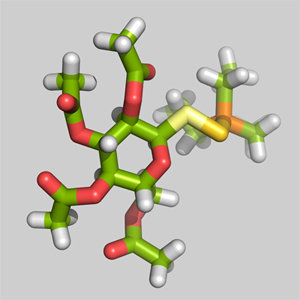 3-D structure of the Auranofin molecule with a gold atom in dark-yellow bound between the light-yellow sulfur and orange phosphorus.
Amebiasis research within the CDIPD is focused on developing drug discovery strategies and identifying novel pharmaceutics for the treatment of this diarrheal disease. Our drug discovery research for amebiasis uses a two-pronged approach, combining a strategy of repurposing compounds that are already in clinical development along with the development of compounds with novel scaffolds and improved activity against the parasite. In addition, our research focuses on the identification of key transcriptional changes as well as the role of proteases in influencing the behavior of pathogenic amebae.
We are also interested in developing innovative technologies for pharmaceutical sciences research and we have developed state-of-the-art technologies to prosecute small molecule discovery in a more rigorous and multidimensional capacity.
- Our research addressed a major question in amebiasis research: why are some organisms capable of producing severe invasive disease whereas others are nonpathogenic?
- We developed shotgun genomic microarray for Entamoeba histolytica. As a complement to microarray analysis, we also applied specific biochemical tools to the study of a cluster of protease genes identified in the pathogen that were hypothesized to play a role in pathogenesis.
- An important finding from our research is that the bacterial biofilm of the colon, mucins produced by intestinal epithelial cells, and sugars like N-acetylgalactosamine (GalNAc) are all key elements in determining whether amebae will express a “commensal” phenotype, or release virulence factors.
- We developed an automated high-throughput screening (HTS) methodology for the E. histolytica viability assay.
- Our HTS methodology discovered the amebicidal activity of an FDA-approved oral drug, auranofin.
- Drug repurposing led to an FDA orphan drug status of auranofin for the treatment of amebiasis.
- Auranofin, with support from the National Institutes of Health (NIH), completed Phase 2 clinical trial for amebiasis.
Our studies are providing important new clues about how a pathogen orchestrates responses to the host environment. The knowledge generated in these studies will help generate new types of therapeutics for the treatment of amebiasis and other amebic infections.
 |
|||
|
|
|
|
Amebiasis Publications
- Nitroimidazole carboxamides as antiparasitic agents targeting Giardia lamblia, Entamoeba histolytica and Trichomonas vaginalis. (opens in a new tab) Eur J Med Chem. 2016 Sep 14;120:353-62. doi: 10.1016/j.ejmech.2016.04.064. Epub 2016 Apr 27.
- X-ray structures of thioredoxin and thioredoxin reductase from Entamoeba histolytica and prevailing hypothesis of the mechanism of Auranofin action. (opens in a new tab) J Struct Biol. 2016 May;194(2):180-90. doi: 10.1016/j.jsb.2016.02.015. Epub 2016 Feb 12.
- Heat shock protein 90 inhibitors repurposed against Entamoeba histolytica. (opens in a new tab) Front Microbiol. 2015;6:368. doi: 10.3389/fmicb.2015.00368.
- Hsp90 inhibitors as new leads to target parasitic diarrheal diseases. (opens in a new tab) Antimicrob Agents Chemother. 2014 Jul;58(7):4138-44. doi: 10.1128/AAC.02576-14. Epub 2014 May 12.
- A reprofiled drug, auranofin, is effective against metronidazole-resistant Giardia lamblia. (opens in a new tab) Antimicrob Agents Chemother. 2013 May;57(5):2029-35. doi: 10.1128/AAC.01675-12. Epub 2013 Feb 12.
- Reprofiled drug targets ancient protozoans: drug discovery for parasitic diarrheal diseases. (opens in a new tab) Gut Microbes. 2013 Jan-Feb;4(1):66-71. doi: 10.4161/gmic.22596. Epub 2012 Nov 8. Review.
- A high-throughput drug screen for Entamoeba histolytica identifies a new lead and target. (opens in a new tab) Nat Med. 2012 Jun;18(6):956-60. doi: 10.1038/nm.2758.
- An image-based assay for high throughput screening of Giardia lamblia. (opens in a new tab) J Microbiol Methods. 2011 Mar;84(3):398-405. doi: 10.1016/j.mimet.2010.12.026. Epub 2011 Jan 22.
- Novel non-peptidic vinylsulfones targeting the S2 and S3 subsites of parasite cysteine proteases. (opens in a new tab) Bioorg Med Chem Lett. 2009 Nov 1;19(21):6218-21. doi: 10.1016/j.bmcl.2009.08.098. Epub 2009 Sep 3.
- A contiguous compartment functions as endoplasmic reticulum and endosome/lysosome in Giardia lamblia. (opens in a new tab) Eukaryot Cell. 2009 Nov;8(11):1665-76. doi: 10.1128/EC.00123-09. Epub 2009 Sep 11.
- Identification of the major cysteine protease of Giardia and its role in encystation. (opens in a new tab) J Biol Chem. 2008 Jun 27;283(26):18024-31. doi: 10.1074/jbc.M802133200. Epub 2008 Apr 29.
- Transcriptional and secretory responses of Entamoeba histolytica to mucins, epithelial cells and bacteria. (opens in a new tab) Int J Parasitol. 2007 Jul;37(8-9):897-906. Epub 2007 Feb 12.
- A phagocytosis mutant of Entamoeba histolytica is less virulent due to deficient proteinase expression and release. (opens in a new tab) Exp Parasitol. 2007 Feb;115(2):192-9. Epub 2006 Sep 20.
- Giardia lamblia cysteine proteases. (opens in a new tab) Parasitol Res. 2006 Sep;99(4):313-6. Epub 2006 Apr 6. Review. No abstract available.
- Entamoeba histolytica: Characterization of human collagen type I and Ca2+ activated differentially expressed genes. (opens in a new tab) Exp Parasitol. 2005 Jul;110(3):214-9. Epub 2005 Apr 8.
- Identification of genomic responses to collagen binding by trophozoites of Entamoeba histolytica. (opens in a new tab) J Infect Dis. 2004 Aug 1;190(3):448-57. Epub 2004 Jul 2.
- A surface amebic cysteine proteinase inactivates interleukin-18. (opens in a new tab) Infect Immun. 2003 Mar;71(3):1274-80.
- Homology modeling of Entamoeba histolytica cysteine proteinases reveals the basis for cathepsin L-like structure with cathepsin B-like specificity. (opens in a new tab) Arch Med Res. 2000 Jul-Aug;31(4 Suppl):S63-4. No abstract available.
- A primitive enzyme for a primitive cell: the protease required for excystation of Giardia. (opens in a new tab) Cell. 1997 May 2;89(3):437-44.
- Pathogenesis in amebiasis: is it genetic or acquired? (opens in a new tab) Infect Agents Dis. 1992 Feb;1(1):11-4. Review. No abstract available.
- A unique cysteine proteinase gene of pathogenic Entamoeba histolytica correlates with virulence. (opens in a new tab) Arch Med Res. 1992;23(2):181-2.
- Detection of HIV-1 in Entamoeba histolytica without evidence of transmission to human cells. (opens in a new tab) AIDS. 1991 Jan;5(1):93-6.
- Entamoeba histolytica: correlation of the cytopathic effect of virulent trophozoites with secretion of a cysteine proteinase. (opens in a new tab) Exp Parasitol. 1990 Aug;71(2):199-206.
- [Direct relation between secretion of proteolytic enzymes and virulence in Entamoeba histolytica]. (opens in a new tab) Arch Invest Med (Mex). 1990;21 Suppl 1:133-8. Spanish. No abstract available.
- Thiol proteinase expression and pathogenicity of Entamoeba histolytica. (opens in a new tab) J Clin Microbiol. 1989 Dec;27(12):2772-7.
- Cleavage of C3 by a neutral cysteine proteinase of Entamoeba histolytica. (opens in a new tab) J Immunol. 1989 Jul 1;143(1):189-95.
- The major neutral proteinase of Entamoeba histolytica. (opens in a new tab) J Exp Med. 1986 Mar 1;163(3):536-49.